People do not change
Along for the RidePeople do not change is Auden’s mother’s governing belief about character: age, in her view, deepens existing habits rather than softening them. The idea grows out of her experience of Robert’s limited participation in raising Hollis, then becomes a lens through which she judges his current relationship with Heidi and their newborn daughter, Thisbe. Its significance lies not in proving that change is impossible, but in the pressure it places on Auden’s hope that people may act differently from the way they did before.
Origin in family experience
Auden’s mother presents her belief as a conclusion drawn from domestic life, not as an abstract maxim. She recalls that Robert changed a diaper only occasionally and would not get up for night feedings, saying that he needed nine hours of sleep in order to teach. She regards that explanation as convenient, because it left her to manage the demands of caring for a baby while he protected his rest.
Her memory gives the principle its emotional force. She remembers sitting in the bedroom while Hollis screamed and wishing Robert would come through the door, take the child, and let her rest. The recollection ends in a broader, more desolate need: eventually she wished not specifically for Robert, but for anyone to come and help. The claim that people do not change is therefore bound to an experience of waiting for support that did not arrive. It describes, in her account, not only Robert’s repeated conduct but the loneliness and exhaustion that repetition produced.
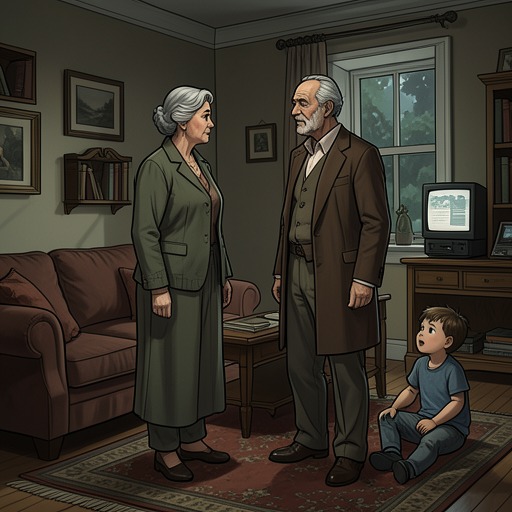
The conversation also makes that history physical in the present. As Auden’s mother speaks, she looks out the window, holding her mug suspended between the table and her lips. Auden carefully gathers her cards back into order and gets ready to leave. The small gestures mark a strained exchange: her mother has exposed an old hurt, while Auden, whose activities have already been under scrutiny, withdraws rather than prolonging the discussion.
A rule passed on to Auden
Auden initially leaves room for the possibility that Robert has changed. Her mother answers that people become more set in their ways with age, and Auden recognizes the lesson as one she has heard before. The exchange gives the concept the form of a family refrain: it is not merely the mother’s judgment about Robert, but a rule she expects Auden to remember and apply.
That rule returns when they discuss Hollis and Tara. Auden suggests that Hollis may have changed and could become engaged to Tara; her mother responds by asking what she has taught Auden about people changing. Auden supplies the familiar answer, and her mother confirms it. The moment shows how easily an account of one man’s past becomes a general formula for judging other people. It also shows Auden participating in the refrain without fully surrendering her own alternative: she has just imagined that Hollis’s future might differ from his past.
The repeated lesson creates a tension between inheritance and judgment. Auden knows her mother’s position well enough to state it back, but the fact that she continues to imagine change suggests that repetition has not made the belief unquestionable. The concept is thus both an explanation her mother offers and a family script Auden is learning to test.
Robert’s present behavior under scrutiny
The dispute acquires new urgency as Auden describes Robert’s summer. He says he is nearly finished with his book and still has tightening to do; her mother observes that the work seems to take all day, every day. When asked whether he helps Heidi with the baby, Auden hesitates before explaining that Heidi is determined to manage on her own. Her mother rejects the idea that someone would want to be the sole caregiver of a newborn, interpreting such a claim as evidence that the person may have no real choice.
That interpretation draws directly on her own experience with Robert, but the later argument Auden overhears gives the present conflict concrete terms. Robert says that he and Heidi had discussed his need for nine hours of sleep during pregnancy, and that finishing the book over the summer matters because he cannot work uninterrupted during the academic year. He also says he proposed hiring a nanny or babysitter, which Heidi did not want. His account supplies reasons for his choices, but it does not erase the imbalance that his wife is asking him to address: she suggests that he take the baby during the day or in the morning so she can deal with work.
The parallel with Auden’s mother’s memory is pointed. Robert again invokes sleep and work as limits on his availability, while a woman caring for a baby asks for practical relief. The resemblance helps explain why Auden’s mother expects the old pattern to continue. Yet the argument does not establish that every circumstance is identical: the proposed childcare arrangement and Heidi’s response are part of this conflict, and the available scene does not resolve what Robert will do next.
Repetition, conflict, and uncertainty
Auden’s experience of the household reinforces the sense that conflict persists beyond a single exchange. After dinner with Robert, she stays away by walking on the beach and taking the longest route home, recognizing that a fight may have only begun rather than ended. Two hours later, she hears Robert and Heidi arguing about his work, his promised presence at dinner, and the family’s need to eat together. The episode gives repetition a structure: tension is not confined to a declaration about people; it resurfaces in ordinary decisions about time, caregiving, and shared life.
The next morning, Auden notices that the argument remains unresolved when Robert and Heidi look at one another in a distinctly cold silence. Robert then comments on how late Auden has been going to bed. The scene does not settle whether Robert can change, but it leaves the mother’s belief hovering over conduct that has not yet altered enough to reassure anyone. His stated plans and explanations sit beside Heidi’s unmet requests and Auden’s mother’s remembered disappointment.
As a recurring concept, People do not change links the household’s present friction to its past without reducing the two to a simple verdict. Auden’s mother speaks from accumulated experience; Auden keeps open the possibility of a different outcome; and Robert’s explanations reveal both intention and continued limits. The refrain matters because it makes change a question the family must confront through action, not a conclusion supplied in advance by memory.